.png)
.png)
.png)


.png) Calculatrices
CalculatricesLithium-Ion vs Sodium-Ion Batteries: What Will Power Europe’s Energy Future?
octobre 16, 2026
As Europe continues its transition towards a more flexible and sustainable energy system, battery storage is becoming increasingly important across residential, commercial and mobile applications.
Lithium-ion batteries remain a leading technology, supported by established manufacturing, mature supply chains and proven applications. Meanwhile, sodium-ion batteries are emerging as a potential alternative, offering new possibilities for battery development and supply chain diversification.
Rather than one technology simply replacing the other, the future is likely to involve different battery chemistries serving different needs.
1. Two Technologies, Different Strengths
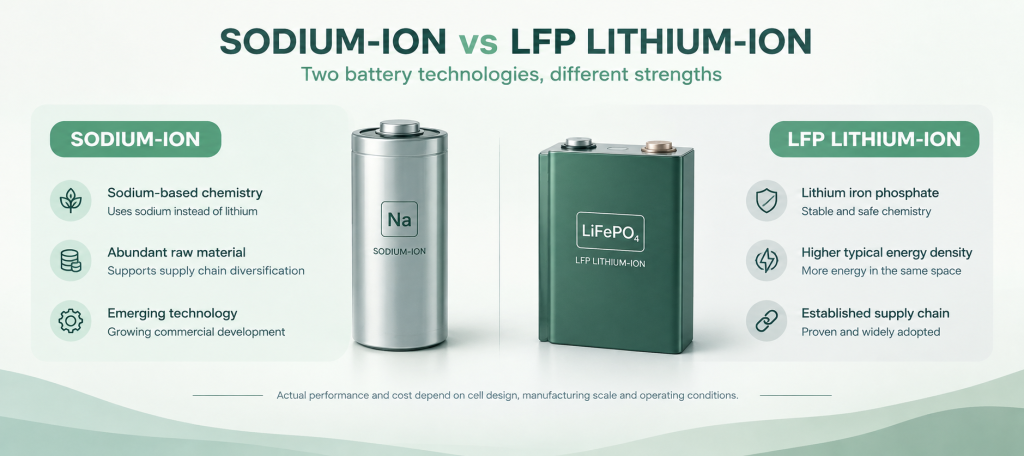
Phosphate de fer et de lithium (LFP), a type of lithium-ion battery, is widely used in energy storage and mobile power applications. Its advantages include good thermal stability, long cycle-life potential and an established supply chain.
Sodium-ion batteries use sodium instead of lithium as the charge-carrying ion. Sodium is abundant, offering opportunities to diversify raw material sources. Some sodium-ion designs also show promising low-temperature performance, although commercial maturity and cost competitiveness continue to vary.
| Key factor | Phosphate de fer et de lithium (LFP) | Sodium-ion |
|---|---|---|
| Energy density | Generally higher | Generally lower |
| Technology maturity | Established | Still developing |
| Low-temperature performance | Depends on cell and system design | Promising in some designs |
| Raw material supply | Relies on lithium and other materials | Benefits from abundant sodium resources |
| Cost competitiveness | Benefits from established manufacturing scale | Depends on production scale and system design |
According to the International Energy Agency (IEA), leading sodium-ion cells can reach around 175 Wh/kg, compared with up to 205 Wh/kg for leading LFP cells. These figures are representative cell-level values, and actual performance varies by product and design.
2. Low-Temperature Performance: Look Beyond the Chemistry
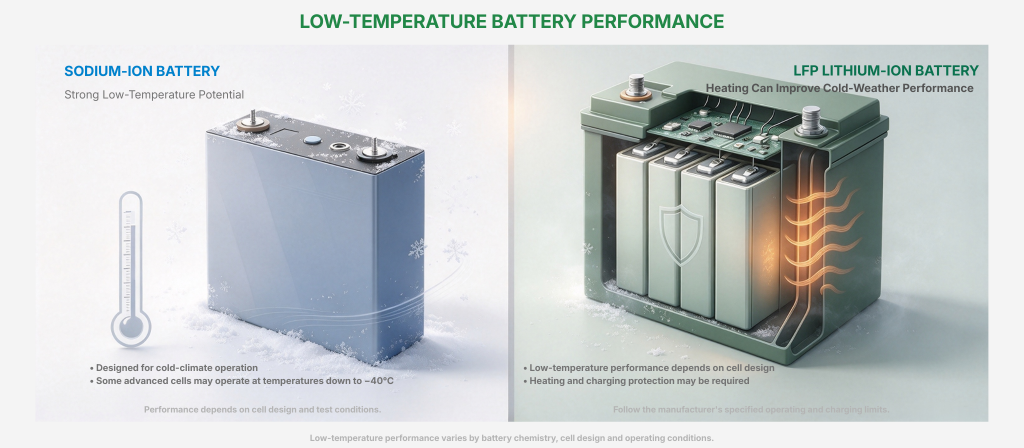
Europe’s varied climate makes temperature performance an important consideration when selecting a battery. Cold conditions can affect available capacity, discharge performance and charging behaviour.
Some sodium-ion technologies show potential advantages in cold environments. Cependant, performance depends on the specific cell chemistry, operating conditions and system design.
LFP batteries can also be designed for colder climates through integrated heating, temperature monitoring and appropriate charging protection.
For buyers, the most useful indicators are verified operating-temperature ranges, charging limits and product-specific test data — not chemistry alone.
3. Coût, Safety and European Compliance
The abundance of sodium creates opportunities for alternative battery supply chains, but lower raw material costs do not automatically translate into a cheaper battery system. Manufacturing scale, energy density, integration and production efficiency all influence overall cost.
Safety also depends on more than cell chemistry. Battery management systems (GTC), gestion thermique, protection mechanisms and manufacturing quality all play important roles.
For businesses serving the European market, regulatory compliance and traceability are equally important. The EU Batteries Regulation (UE) 2023/1542 introduces requirements covering areas such as sustainability, labelling and battery information.
From 18 February 2027, a battery passport will be required for batteries within the regulation’s specified categories, including electric vehicle batteries, light means of transport batteries and industrial batteries with a capacity greater than 2 kWh. The exact obligations depend on the battery category and applicable provisions.
Reliable technical documentation and relevant compliance information are therefore important considerations when evaluating battery suppliers.
4. Choosing the Right Battery for the Application
For motorhomes, caravanes, camping-cars, marine systems and off-grid power, LFP batteries remain a practical choice for many applications, combining established technology with good cycle-life potential and relatively high energy density.
Sodium-ion batteries may become suitable for selected stationary storage and cold-climate applications, depending on their verified performance, system requirements and commercial availability.
The right choice should be based on usable capacity, operating temperature, charging requirements, service life, safety design and total cost of ownership.
5. de Watt: Matching Battery Technology to Real-World Needs
Chez Wattnova, we believe that effective energy solutions start with understanding the application.
Our focus is on LiFePO₄ battery solutions for the European market, supporting applications including mobile power, marine and off-grid energy systems. We value practical performance, reliability and suitability for real-world operating conditions.
As battery technologies continue to evolve, LFP remains an important solution for today’s market, while sodium-ion technology may open up further opportunities for specific applications in the future.
The future of energy storage is not simply about one battery technology replacing another. It is about finding the right balance of performance, reliability and application needs.
Wattnova — Exploration Never Ends.