.png)
.png)
.png)


.png) Calculadoras
Calculadoras¿Cómo está respondiendo Wattnova a las tendencias en baterías de litio y a las regulaciones sobre la huella de carbono de la UE??
junio 4, 2026
La transición energética global se está acelerando, y las baterías de litio están en el centro de esta transformación. De vehículos eléctricos (vehículos eléctricos) a sistemas de almacenamiento de energía (ESS) y vehículos eléctricos de baja velocidad como carritos de golf, la demanda de baterías de iones de litio, especialmente LiFePO4 (baterías LFP), sigue creciendo rápidamente.
Al mismo tiempo, El mercado europeo está atravesando un cambio estructural impulsado por las políticas de sostenibilidad., particularmente en torno a la huella de carbono, trazabilidad de la batería, y el próximo Reglamento de baterías de la UE.
Para fabricantes, distribuidores, e importadores, Ya no se trata sólo de rendimiento y precio, sino de cumplimiento., transparencia, y responsabilidad ambiental a largo plazo.
Este artículo explora tres aspectos clave:
- -Tendencias futuras en la tecnología de baterías de litio
- -La importancia de la huella de carbono y el etiquetado de carbono en Europa
- -Cómo Wattnova está respondiendo a estos cambios de la industria
1. Tendencias futuras en la tecnología de baterías de litio
1.1 Cambio hacia la LFP (LiFePO4) Baterías
Una de las tendencias más importantes es la rápida adopción de baterías LFP. (Fosfato de hierro y litio).
En comparación con las baterías NMC, ofertas LFP:
- -Ciclo de vida más largo (3000–6000 ciclos)
- -Mayor estabilidad térmica (mejor rendimiento de seguridad)
- -Menor costo debido a que no contiene cobalto ni níquel.
- -Cadena de suministro más respetuosa con el medio ambiente
Estas ventajas hacen de LFP la opción preferida para:
- -Carros de golf y vehículos eléctricos de baja velocidad
- -Sistemas de almacenamiento de energía (ESS)
- -Aplicaciones comerciales e industriales
| Característica | Batería LFP | Batería NMC |
|---|---|---|
| Ciclo de vida | 3,000–6.000 ciclos | 1,000–2.500 ciclos |
| Seguridad | Excelente estabilidad térmica | Mayor riesgo de fuga térmica |
| Costo | Más bajo | Más alto |
| Cobalto/Níquel | No requerido | Requerido |
| Impacto ambiental | Más bajo | Más alto |
| Aplicaciones típicas | carritos de golf, ESS, vehículos utilitarios | Vehículos eléctricos de pasajeros |
1.2 El alto rendimiento de descarga se vuelve crítico
En aplicaciones como carritos de golf eléctricos., montacargas, y vehículos utilitarios, alta tasa de descarga (Caja) se está convirtiendo en un diferenciador clave.
Los clientes exigen cada vez más:
- –Fuerte aceleración
- –Voltaje estable bajo carga
- –Rendimiento confiable en pendientes y condiciones de servicio pesado
Esto cambia el enfoque de la “capacidad (ah)" a:
- –Capacidad de descarga
- –Estabilidad de voltaje (hundimiento de bajo voltaje)
- –Sistema de gestión de batería. (BMS) actuación
1.3 Integración de BMS inteligentes y sistemas de datos
Las baterías de litio modernas ya no son dispositivos pasivos de almacenamiento de energía.. Con sistemas avanzados de gestión de baterías (BMS), Las baterías se están convirtiendo en sistemas inteligentes capaces de:
- ✔ Monitoreo en tiempo real (Voltaje, temperatura, actual)
- ✔ Diagnóstico remoto
- ✔ Mantenimiento predictivo
- ✔ Seguimiento de datos para la gestión del ciclo de vida
Esta tendencia está directamente relacionada con los requisitos regulatorios en Europa., especialmente el próximo pasaporte de batería.
2. Huella de Carbono y Etiquetado de Carbono en el Mercado Europeo
2.1 ¿Qué es la huella de carbono de la batería??
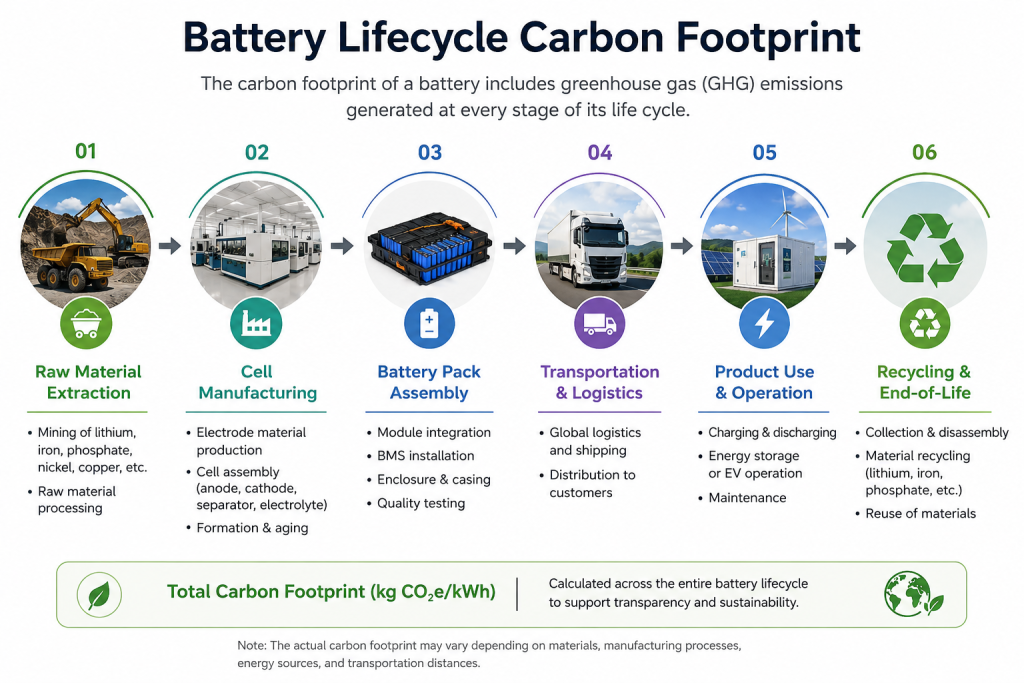
La huella de carbono de una batería se refiere al total de gases de efecto invernadero. (GEI) emisiones generadas a lo largo de su ciclo de vida, incluido:
- -Extracción de materia prima
- -Fabricación de células
- -Montaje del paquete
- -Transporte
- -Reciclaje al final de su vida útil
En Europa, esto se mide en kg de CO₂ por kWh.
2.2 Reglamento de baterías de la UE: Un cambio de juego
El nuevo Reglamento de baterías de la UE (UE) 2023/1542 introduce requisitos estrictos para las baterías que entran en el mercado europeo.
Los requisitos clave incluyen:
- -Declaración obligatoria de huella de carbono
- -Introducción gradual de umbrales de huella de carbono
- -Pasaporte de batería con trazabilidad digital
- -Niveles mínimos de materiales reciclados
- -Normas estrictas de sostenibilidad y diligencia debida
| Requisito | Objetivo |
|---|---|
| Declaración de Huella de Carbono | Medir las emisiones de la batería |
| Umbrales de huella de carbono | Limitar las baterías de altas emisiones |
| Pasaporte de batería | Mejorar la trazabilidad |
| Requisitos de material reciclado | Apoyar la economía circular |
| Reglas de diligencia debida | Garantizar un abastecimiento responsable |
Para empresas que exportan a Europa, El cumplimiento ya no es opcional: es obligatorio..
2.3 Por qué es importante el etiquetado de carbono
El etiquetado de carbono no es sólo un requisito regulatorio: se está convirtiendo en un diferenciador del mercado.. Clientes europeos (especialmente compradores B2B) están priorizando cada vez más:
- -Productos bajos en carbono
- -Cadenas de suministro transparentes
- -ASG (Ambiental, Social, Gobernancia) cumplimiento
En muchas licitaciones y procesos de adquisiciones, Los datos de la huella de carbono ya son un factor decisivo..
3. Cómo responde Wattnova a los cambios de la industria
| Tendencia de la industria | Respuesta de Wattnova |
|---|---|
| Creciente demanda de LFP | Centrarse en los sistemas de baterías LiFePO4 |
| Mayores requisitos de descarga | 1Opciones de descarga C-3C |
| Regulaciones sobre la huella de carbono | Preparación de datos de carbono. |
| Requisitos del pasaporte de batería | Preparación para la trazabilidad |
| Expectativas de seguridad | BMS avanzado & gestión térmica |
3.1 Centrarse en soluciones de baterías LFP de alto rendimiento
Wattnova se centra en sistemas de baterías LiFePO4 diseñados para:
- -carritos de golf
- -Vehículos eléctricos de baja velocidad.
- -Aplicaciones de almacenamiento de energía
Las ventajas clave del producto incluyen:
- -Alta tasa de descarga (1Opciones C-3C)
- -Salida de voltaje estable bajo carga pesada
- -Ciclo de vida largo
- -Optimizado para escenarios de uso del mundo real
3.2 Preparándose para el cumplimiento de las emisiones de carbono
Para alinearse con los requisitos del mercado europeo, Wattnova está trabajando activamente en:
- -Recopilación y cálculo de datos sobre la huella de carbono.
- -Transparencia de la cadena de suministro
- -Colaboración con organismos certificados de ensayo y verificación.
- -Preparación para futuros sistemas de pasaporte de baterías
Esto garantiza que los clientes que importan baterías Wattnova puedan cumplir con los próximos requisitos reglamentarios con confianza..
3.3 Optimización estructural y de seguridad
Más allá del cumplimiento, Wattnova enfatiza la confiabilidad del producto a través de:
- -Diseño de estructura interna reforzada (resistencia a las vibraciones mejorada)
- -BMS avanzado con protección y control de corriente precisos
- -Gestión térmica optimizada
Estas características son particularmente importantes para:
- -Aplicaciones al aire libre
- -Entornos de terreno accidentado
- -Condiciones de funcionamiento de alta carga
3.4 Enfoque de ingeniería orientado al cliente
Wattnova entiende que las aplicaciones del mundo real importan más que las especificaciones en papel.
En lugar de centrarse sólo en:
- -Capacidad nominal (ah)
Wattnova prioriza:
- -Rendimiento de descarga real
- -Compatibilidad del sistema (controlador + motor + batería)
- -Estabilidad operativa a largo plazo
Este enfoque ayuda a los clientes a reducir:
- -Tasas de fracaso
- -Costos de mantenimiento
- -Costo total de propiedad (costo total de propiedad)
4. Conclusión: De la competencia de precios a la competencia de valores
La industria de las baterías de litio está entrando en una nueva fase. En el pasado, la competencia fue impulsada por:
- -Precio
- -Especificaciones básicas
Hoy, los diferenciadores clave son:
- -Rendimiento en condiciones reales
- -Huella de carbono y sostenibilidad
- -Cumplimiento de la normativa internacional
- -Transparencia y trazabilidad
Para empresas dirigidas al mercado europeo, Adaptarse a estos cambios no es opcional, es esencial.. Wattnova se compromete a apoyar a sus socios durante esta transición brindándoles:
- -Soluciones de baterías LFP de alto rendimiento
- -Productos listos para el cumplimiento
- -Soporte técnico y comercial a largo plazo.